
Ai is no longer a advanced concept. Today AI agents or tools work like digital employees (workers) who never sleep or never complain and never ask for a salary. Businesses and individuals now rely on the power of an intelligent agent in AI to automate repetitive tasks or generate income streams and scale operations quickly.
This article explains how AI agents function how they help you earn and how you can start building your own automation system.
What Are AI Agents and Why They Matter
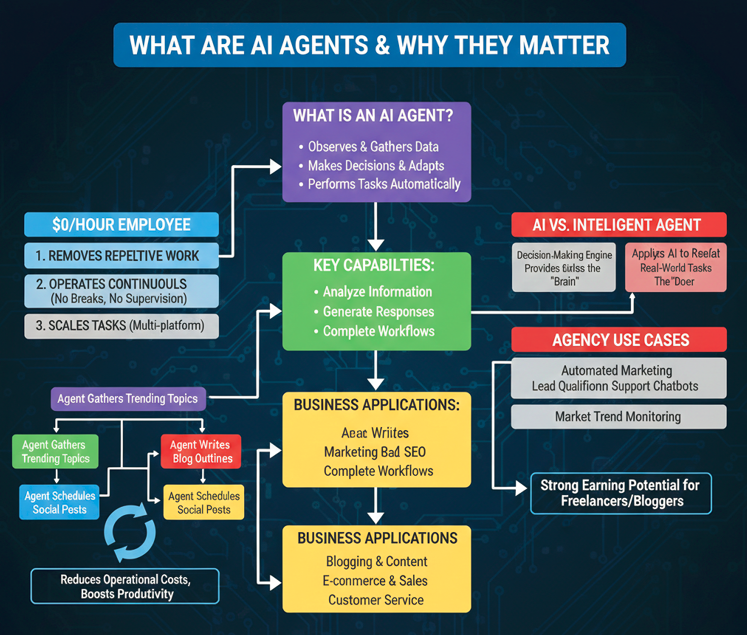
An ai intelligent agent is a system that observes data or makes decisions and performs tasks automatically. Basic automation tools such as AI agents learn from interactions and adapt to new situations. Therefore they work as decision making assistants rather than simple scripts.
AI agents analyze information AI agents generate responses. AI agents complete workflows. Because of these capabilities they support blogging, marketing, e commerce, research, and customer service.
Competitors emphasize monetization strategies such as automation services, content generation, and analytics agents. However many teach miss practical setup and real workflow examples. That gap gives you an opportunity to create unique content and build authority.
How AI Agents Act Like a $0/hr Employee
First AI agents remove repetitive manual work such as they can collect data or create reports and send emails automatically. Second they operate continuously. They never need breaks or supervision. Third they scale tasks across multiple platforms.
Consider this workflow:
- The agent gathers trending topics from search data.
- The agent writes optimized blog outlines.
- The agent schedules posts across social media.
- The agent analyzes performance metrics weekly.
Because the system runs automatically you reduce functional costs while increasing efficiency.
Artificial Intelligence and Intelligent Agents in Business
The relationship between artificial intelligence and intelligent agents is simple. Artificial intelligence provides the decision making engine. Intelligent agents apply that intelligence to real world tasks. As a result companies integrate agents into customer service or lead generation and analytics workflows.
For instance, an artificial intelligence agency might deploy agents to handle:
- Automated marketing campaigns
- Lead qualification systems
- Customer support chatbots
- Market trend monitoring
Businesses pay agencies to build and manage these agents this model creates strong earning potential for freelancers and bloggers who teach or implement automation.
Intelligent Agent in Artificial Intelligence Examples
Understanding real examples makes the concept clearer:
- Content Creation Agent
Generates blog outlines, keywords, and drafts based on search trends. - E-commerce Optimization Agent
Updates product descriptions, pricing strategies, and inventory alerts. - Customer Support Agent
Answers questions, routes tickets, and tracks feedback. - SEO Research Agent
Analyzes keyword gaps, competitor strategies, and search rankings. - Email Marketing Agent
Writes personalized newsletters and schedules campaigns automatically.
Each example demonstrates how automation reduces manual work while improving consistency and speed.
How to Build Income Streams With AI Agents
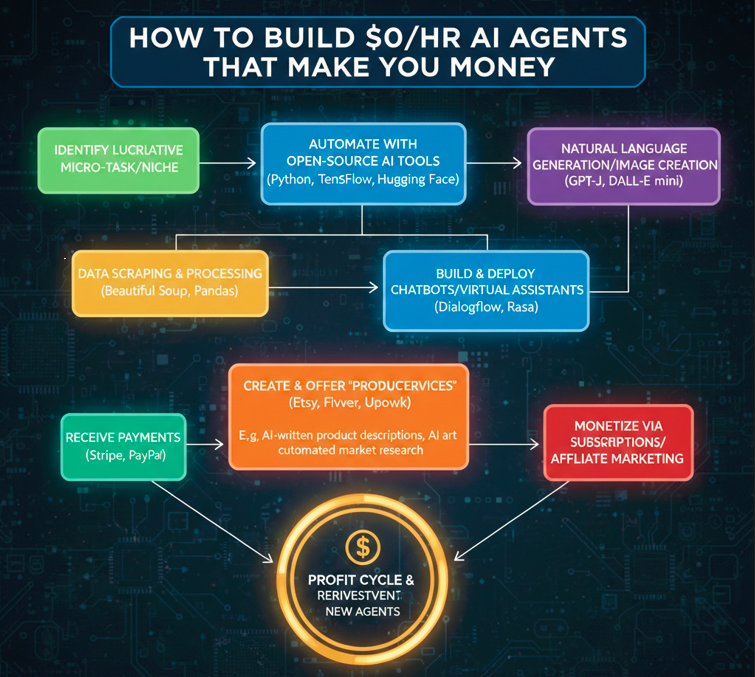
You can monetize AI agents in multiple ways. Each method aligns with current competitor strategies but adds unique value through implementation depth.
1. Launch an AI Agency
Start an ai agency that builds automation systems for businesses. Offer setup packages and monthly maintenance. Focus on small companies that want efficiency but lack technical expertise.
2. Sell AI Agent Templates
Design reusable workflows such as content pipelines or lead capture systems. Then sell templates on digital marketplaces. Templates require initial effort but produce recurring income.
3. Create Automated Content Websites
Use agents to generate outlines, keyword research, and posting schedules. Maintain editorial control. Combine automation with quality editing to build scalable niche blogs.
4. Provide Consulting and Training
Many businesses want to adopt automation but feel overwhelmed. Offer workshops and online courses explaining intelligent agent setup and management.
Step-by-Step Guide to Creating Your First AI Agent
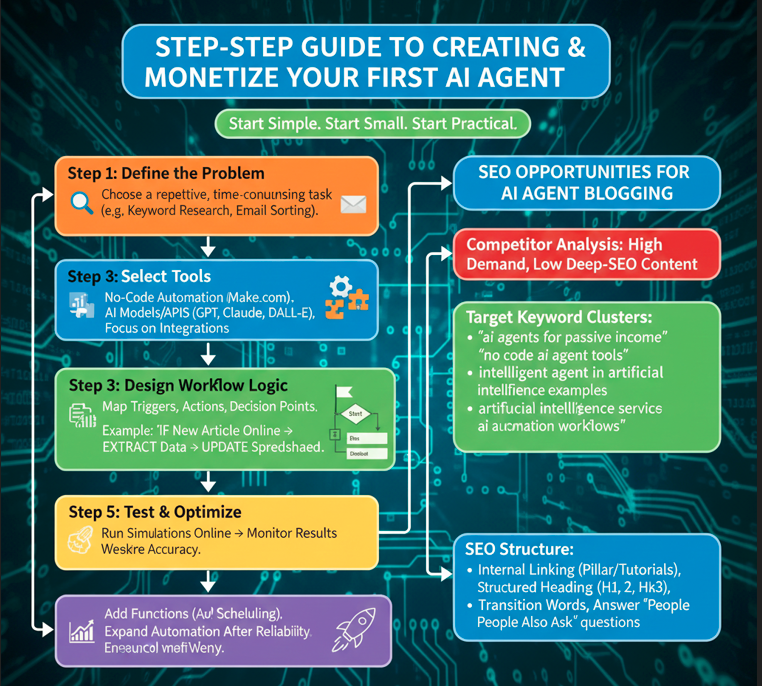
Start simple. Start small. Start practical.
Step 1: Define the Problem
Choose a repetitive task such as keyword research or email sorting.
Step 2: Select Tools
Use no-code automation platforms combined with AI models. Focus on integrations that connect multiple apps.
Step 3: Design Workflow Logic
Map triggers, actions, and decision points. For example, if new content appears online, your agent extracts data and updates a spreadsheet.
Step 4: Test and Optimize
Run simulations. Adjust prompts and decision rules. Monitor results weekly to ensure accuracy.
Step 5: Scale Gradually
Add additional functions like analytics reporting or content scheduling. Expand automation once the core system works reliably.
SEO Opportunities for AI Agent Blogging
Competitor analysis reveals strong demand for monetization tutorials. However, many posts lack deep SEO structure. You can outperform them by targeting keyword clusters such as:
- ai agents for passive income
- no code ai agent tools
- intelligent agent in artificial intelligence examples
- ai automation workflows
- artificial intelligence agency services
Use internal linking between pillar articles and supporting tutorials. Add structured headings. Include transition words to maintain readability. Furthermore, answer specific questions that beginners search for online.
Practical Tips to Maximize AI Agent Productivity
Use clear prompts. Use measurable goals. Use consistent workflows.
First, write precise instructions so agents understand tasks. Second, track performance metrics such as output quality and time savings. Third, maintain human oversight to ensure ethical and accurate content creation.
Additionally, combine multiple agents into a single ecosystem. For example, one agent gathers data, another writes content, and another distributes posts. This layered automation multiplies productivity without increasing workload.
Challenges and How to Overcome Them
AI automation brings enormous benefits. However, it also requires careful planning.
- Over-automation: Maintain manual checks to avoid errors.
- Poor prompts: Continuously refine instructions for clarity.
- Integration issues: Test each connection thoroughly before scaling.
When you address these challenges early, your automation system becomes reliable and scalable.
The Future of AI Agents and Income Automation
AI agents will become smarter, more autonomous, and more specialized. Businesses will rely on intelligent systems for research, marketing, and decision-making. Therefore, bloggers and creators who understand this technology now will gain a strong competitive advantage.
Because automation reduces operational costs, companies will continue investing in intelligent agents. Because digital entrepreneurship grows rapidly, more individuals will explore AI-driven income streams. Because technology evolves quickly, ongoing learning remains essential.
Conclusion
AI agents represent the next phase of digital productivity. They function as $0/hr employees who handle repetitive work while you focus on strategy and creativity. By understanding the fundamentals of an intelligent agent in AI, finding real use cases and implementing monetization strategies, you can transform automation into sustainable income.
Begin with a simple workflow. Expand your system gradually. Combine human expertise with machine efficiency. When you master these principles, AI agents become powerful partners in building scalable online businesses.